• Published on

    RATHER

    Picture

    The word “rather” is common in everyday situations, having several meanings and applications that native English speakers take for granted. In writing, however, using “rather” causes some concern because of uncertainty regarding the placement of associated commas.

    ​The main thing to remember is that “rather” almost never takes a comma, but when it does, the comma is most often one of a pair that serves to set something apart and make it nonessential (hence, parenthetical) to the core meaning of the sentence. Finding “rather” attached to a single comma is rather rare.  

    When rather's not essential,
    Two commas separate it,
    And comma unilateral
    Is never there permitted.

    It's parenthetically
    Diverting us with data
    That's not required really,
    A smoothish operator.

    “One doesn't wish to linger
    But, rather, keep on going;
    The time to rest is yonder
    When past the area daring.”


    A single comma seldom
    With safety is abounding,
    And “rather” feels more winsome 
    With commas—two—attending.

    So, “rather,” almost certain,
    Eschews a single comma,
    Unless conjunctive curtain
    It hangs before the comma.

    In being conjunctive adverb, 
    Connective function serving,
    It joins two parts that contrast
    Across a stop or such thing;

    A semicolon often,
    The bridge for many takers,
    To “rather” then will shunt them,
    Suggesting comma spacer.

    “Let's not hold on to doubting
    Forever; rather, let us 
    Advance with faith, asserting
    That grace removes all onus.”


    But when a simple adverb,
    With meaning only “fairly,”
    Or when it tells of preference,
    Degree, or if exactly,

    Or “rather than“ in complex
    (With words between or after),
    No comma leads and ushers
    That “rather” in its barter.

    “I'd rather peel an apple
    Than juice a yellow lemon;
    Get flavor rather subtle,
    Not rather tempt a demon.”

  • Published on

    GOPHER

    Picture

    The field was full of tasty treats
    Before that creature came
    And packed a cheek with snacks to keep
    Its “pocket gopher” name.

    Arose then gopher cones of dirt
    From tunnel rooms unseen,
    As kingdom spaces underground 
    Were swept to keep them clean.

    Inviting though the prospect was
    To venture down below,
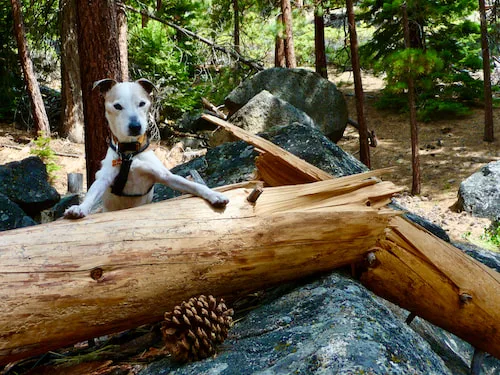
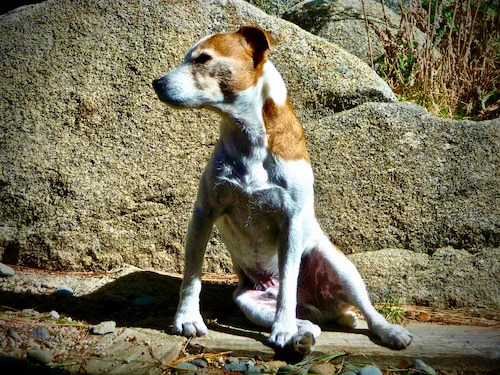
    My canine snout would barely fit,
    Much less my body go.

    A bigger hole came into mind,
    With thoughts of digging through,
    But Lordly care did make it fair
    Destruction to eschew.

    —Shortfellow (aka Lord Zakwoof of Glenwoof)

  • Published on

    THE DOG'S NICHE

    Picture

    ​[Inspired by Hughes Mearn's Antigonish]

    Yesterday while in the park,
    I met a dog who didn't bark.
    He didn't bark again today;
    And yet a lot he had to say.

    For though his lips were standing still,
    There was a tree he'd marked at will.
    I cocked a leg and promptly peed
    To leave no doubt that I could read.

    This evening when I sniffed near home,
    I caught a message in the loam
    To check the trees along the walk
    So he could have a little talk.
    ​ 

    —Shortfellow (aka Lord Zakwoof of Glenwoof)

  • Published on

    PRELUDE

    Picture

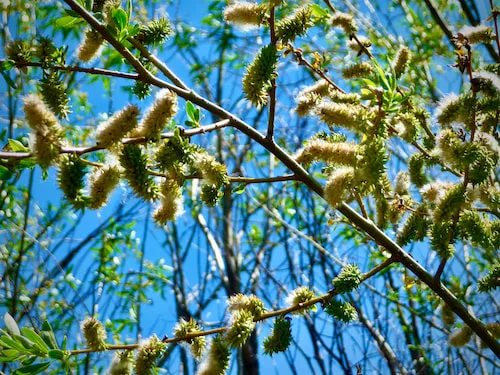
    Pillows of willows rolling in meadows,
    Marking the course of a singular creek;
    Blushing the landscape with plumes of sienna,
    Prelude to springtime and greenery most chic.

    Subtle the colors, as just now awakening,
    Wispy the leaves on tentative stems;
    Barely surpassing their spectral origins,
    Buds sitting quietly like genies and gems.

    Strangely low key is this vital transition,
    Muted the scene in a year-long play;
    Moment of poignancy vested with purpose,
    On its way a season to sway.

  • Published on

    CHINQUAPIN

    Picture

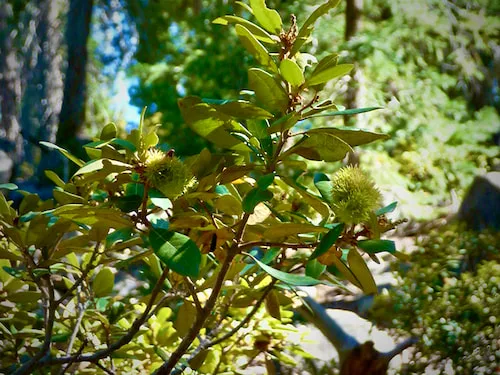
    This chinquapin with gold-backed leaves
    May tantalize the gaze,
    But spiny fruit that grow thereon 
    With hazards will amaze.

    Their spines when young the brave will dare
    To lightly test with touch,
    To brush a fuzzy-looking sphere,
    To think it's not too much.

    If flying hedgehogs lived indeed,
    This bush would camouflage;
    Provide a nest above the herd,
    A safety net enlarge.

    I keep a watchful canine eye
    When passing just in case
    A pygmy hedgehog drops to earth--
    Oh, what a chance to chase!

    —Shortfellow (aka Lord Zakwoof of Glenwoof)

  • Published on

    A PROOFREADER'S UNEASE

    Picture

    ~Regarding whether in marketing a proofreader might claim to “have proven”~

    That proof is in the pudding
    Is proven after oven;
    But “oven” within “proven”
    Is proved by simple vision.

    So here we see that “proven”
    Is participle likewise
    To “proved” in sentence given;
    No doubt a cause of sad sighs.

    For often it is questioned
    Why these two words should battle
    To prove the most deserving
    To serve as only participle.

    It leaves us quite unsettled
    When choosing “proved” or “proven”:
    What rule “has proved” its truth yet,
    Or what “has proven” certain.

    Though use by country varies,
    Feel safe with “proved” in general.
    It ends in “d” deliberate,
    “Default” the clue in total.

    For adjective, no quandary;
    It's “proven,” recent risen.
    Remember “proved” is also
    The simple past when bidden.